Mirror, Mirror, Off the Wall: What My Phone Taught Me in Twelve Changing Rooms
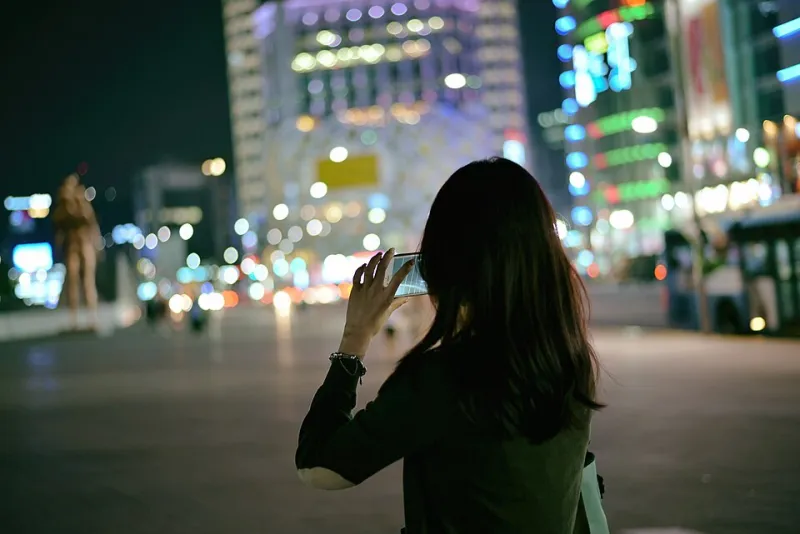
Photo: chelsom tsai from TAIPEI, Taiwam, CC BY 2.0, via Wikimedia Commons
Changing rooms are designed to make a sale. I do not mean that as a conspiracy; I mean it as a fact of geometry and lighting. The mirror is often angled, the bulbs are warm, the cubicle is narrow enough to make you stand up straighter, and there is usually a queue outside applying just enough pressure to make you say yes to something you are not completely sure about. I know all of this, and yet I still get fooled. So I tried a small experiment: in every fitting room, before I made a decision, I took a phone photo. No filters, no clever angles, no contorting myself into a more socially acceptable shape. Just the plain front view, a side view if I could manage it, and sometimes a seated view because that is where most of my real life happens.
Over a few weeks I did this in twelve changing rooms on a fairly predictable UK high-street circuit: Primark, New Look, H&M, Zara, M&S, Next, River Island, Uniqlo, COS, & Other Stories, John Lewis and FatFace. Then I looked at the photos at home, in daylight, with my own shoes, coat and bag nearby. That last part matters. A garment can look perfectly decent under a changing-room spotlight and then meet your actual life like a bad blind date.
The mirror is not lying, exactly
It is just telling a very specific story. Changing-room mirrors are often positioned to lengthen the body and soften the middle. The lighting flatters skin tone and hides texture. The enclosed space encourages a straighter posture. None of this is malicious, but it does mean the version of you in the mirror is not quite the version of you who will be running for a bus in the rain.
The phone photo is not brutally honest either, but it is differently honest. It flattens the lighting, reveals proportions, and shows how the fabric sits when you are not actively holding your stomach in. It also shows the back view, which is the view most of us never properly check. Several times I thought a top was fine until the photo showed it riding up at the back or pulling across the bust. Several times I thought a dress was boring until the photo showed it had a genuinely good line through the shoulder.
The three-photo rule
My version of the test is simple. Photo one: straight on, arms down, phone at chest height rather than held high like I am filming a music video. Photo two: side on, because that is where you see whether a waistband digs in or a jacket hangs properly. Photo three: seated, if the garment is trousers, a skirt, a dress or anything with a fitted waist. Sitting down is the great leveller of high-street clothing. If it strains, rides up or needs constant adjustment when you perch on a changing-room stool, it will do the same on an office chair or a pub bench.
Then I look at the photo before I look at the price tag. If my first thought is that I would need different underwear, a different bra, a different pair of shoes or a different personality to make it work, it is probably not the right buy. I am not against a piece that requires a bit of styling. I am against a piece that requires a complete rewrite of my life.
What the stores taught me
The store itself matters more than I expected. Primark's lighting can be honest to the point of cruelty, which is oddly useful. New Look and H&M are a mixed bag depending on the branch; some fitting rooms are bright and clear, others make everything look slightly sepia. Zara's mirrors are famously flattering, and the queue makes you rush, which is exactly when you should slow down. M&S tends to be warm and kind, which is lovely for the ego but not always reliable for checking whether a knit is see-through in daylight. Next is usually practical and well lit. River Island and Uniqlo tend to show fabric texture fairly clearly. COS and & Other Stories have that calm, minimal lighting that makes even a grey sweatshirt feel like an architectural statement. John Lewis is sensible and bright. FatFace made me realise that a relaxed fit can look slouchy in a good way or simply borrowed from a taller sibling, and the photo told me which was which.
None of this is a ranking. It is just a reminder that the room is part of the try-on. If the lighting is doing a lot of work, take the photo and check it again near a window if you can. If you cannot, buy with the return policy in mind and try it on at home with the tags on.
The practical checks that survived
After twelve rooms, I landed on a short list of checks that actually changed my decisions. First, fabric in motion: sit down, stand up, walk a few steps, reach forward. If it pulls, twists or needs a tug, the fit is not right. Second, transparency: phone torch off, but look at the photo in daylight at home. Third, creasing: some linen and viscose will crease immediately, and that is fine if you like that; it is not fine if you will resent it by 10am. Fourth, pilling and static: run your hand over the fabric and see how it behaves. Fifth, the shoulder and armhole: if a top or jacket does not sit cleanly there, nothing else will fix it.
And sixth, the styling check. I started taking a photo of the item with the shoes I was actually wearing that day, or with the coat I would realistically pair it with. A party top that only works with strappy heels is not much use to me on a Tuesday. A blazer that works over a hoodie and with jeans is worth ten that only work with a silk camisole I do not own.
What I bought, and what I left
The photo test did not make me buy less for the sake of it. It made me buy more deliberately. I left behind a very nice-looking knit that photographed beautifully but felt scratchy at the neck, and a pair of trousers that looked sharp standing up but showed every crease the moment I sat down. I bought a plain black cardigan because the photo showed it sat properly across the shoulders, and a pair of straight-leg jeans because the seated photo did not make me want to lie down on the floor.
The camera is not a verdict. It is a second opinion. Changing-room mirrors are there to sell you a version of yourself; your phone, used plainly, is there to show you the version who has to get dressed in the morning. I will take that over a flattering angle any day.